VicPD and province try to stop release of police “use of force” data
The B.C. government collects data on police use of force reports and publishes excerpts online. But they hold back far more than they share, so I filed an FOI for VicPD’s complete use of force data from 2022 to 2024. VicPD asked the government not to release any of it, and the government agreed.
After multiple successful complaints to the privacy commissioner, I received the data, which I’ve summarized below. With nearly 100 data points for each use of force report, it reveals things like:
How often police injure someone, including people they’ve already jailed
How many times officers say they struck someone
How often police used force on someone in handcuffs
VicPD officers using force during “wellness checks”
VicPD’s “Co-Response Team,” advertised as “support[ing] people in distress,” hurting people, and
A VicPD patrol officer threatening to tase someone accused of littering
VicPD changes its reporting to disclose fewer incidents
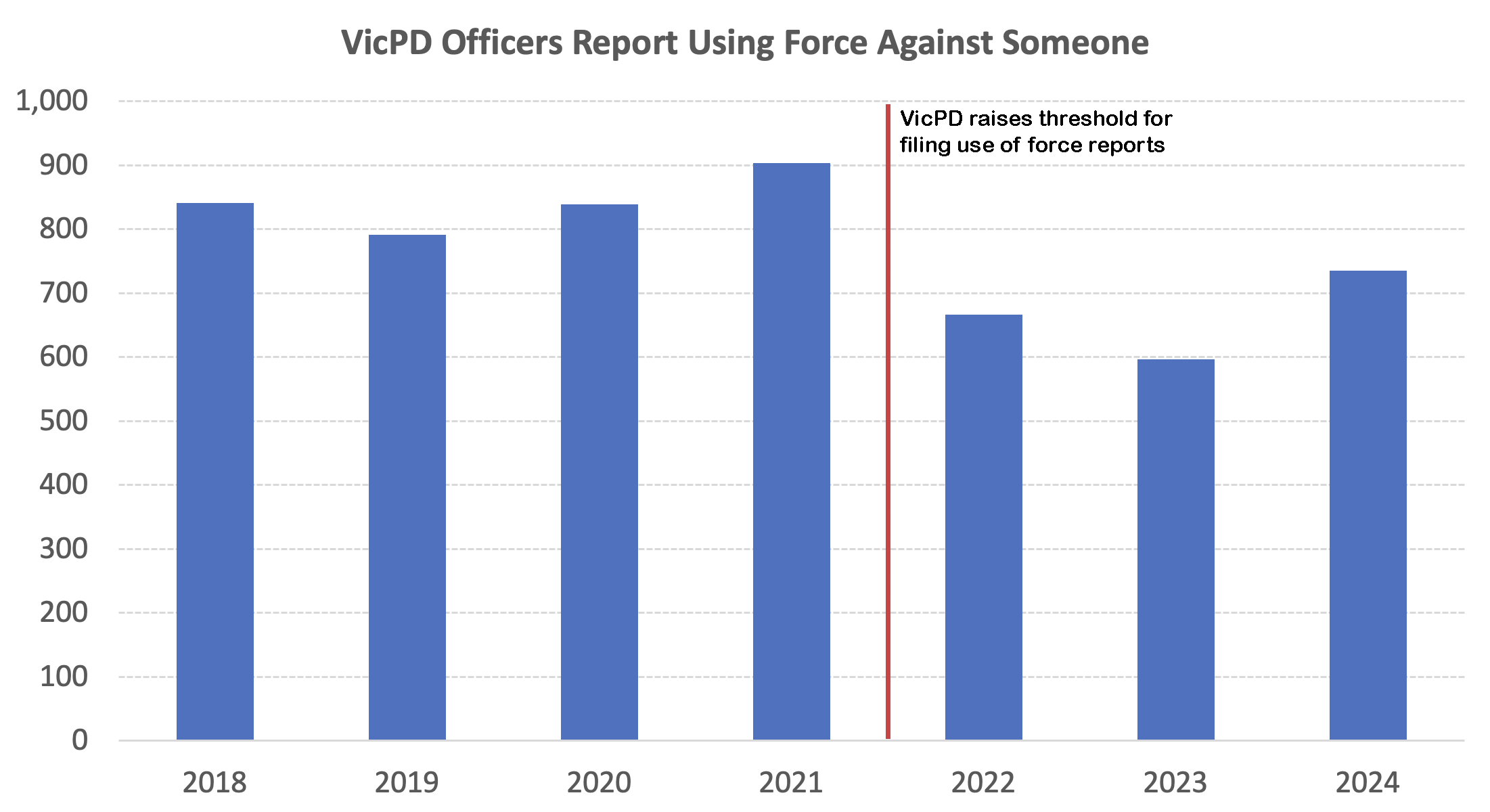
I previously requested the same use of force data for 2018 to 2021. The first thing that’s noticeable in the 2022 to 2024 data is that VicPD is filing fewer use of force reports. From a high of 903 in 2021, the number of reports fell to a low of 596 in 2023, before rising again to 735 in 2024.
You might think that fewer use of force reports would mean VicPD is using less force, but it’s not that simple. In 2022, VicPD’s use of force reports fell by 26%. But that was the year VicPD said they “revised [their] policy on reportable use of force to align with provincial standards, better defining the threshold for submitting a report.” They said they had been “over-reporting compared to other agencies.”
Before 2022, VicPD’s use of force reports were creeping upwards. Given that VicPD raised its reporting threshold, it’s possible that VicPD is still using as much or more force than they were before.
Threatening to shoot people five times a week
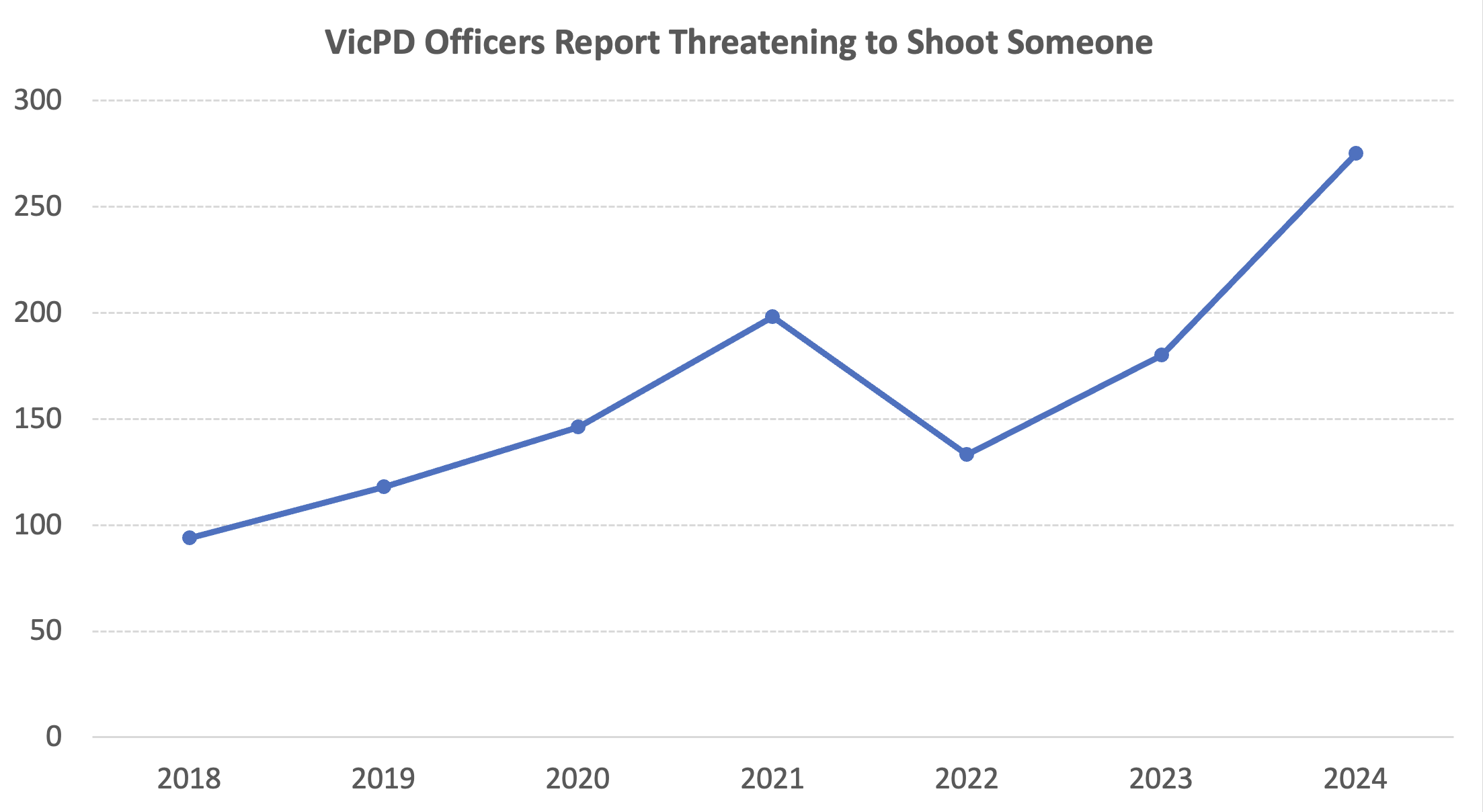
Because VicPD is choosing to report fewer uses of force, it’s interesting to see what’s going up anyway. The most alarming is how often VicPD officers are threatening to shoot people, either “drawing and displaying” their guns “for the purpose of generating compliance,” or pointing them directly at someone. VicPD officers filed 275 reports in 2024 where they threatened to shoot someone, including 197 times where they pointed their gun at the person. In 2024, VicPD filed more than five reports a week where an officer threatened to shoot someone, and they shot twice.
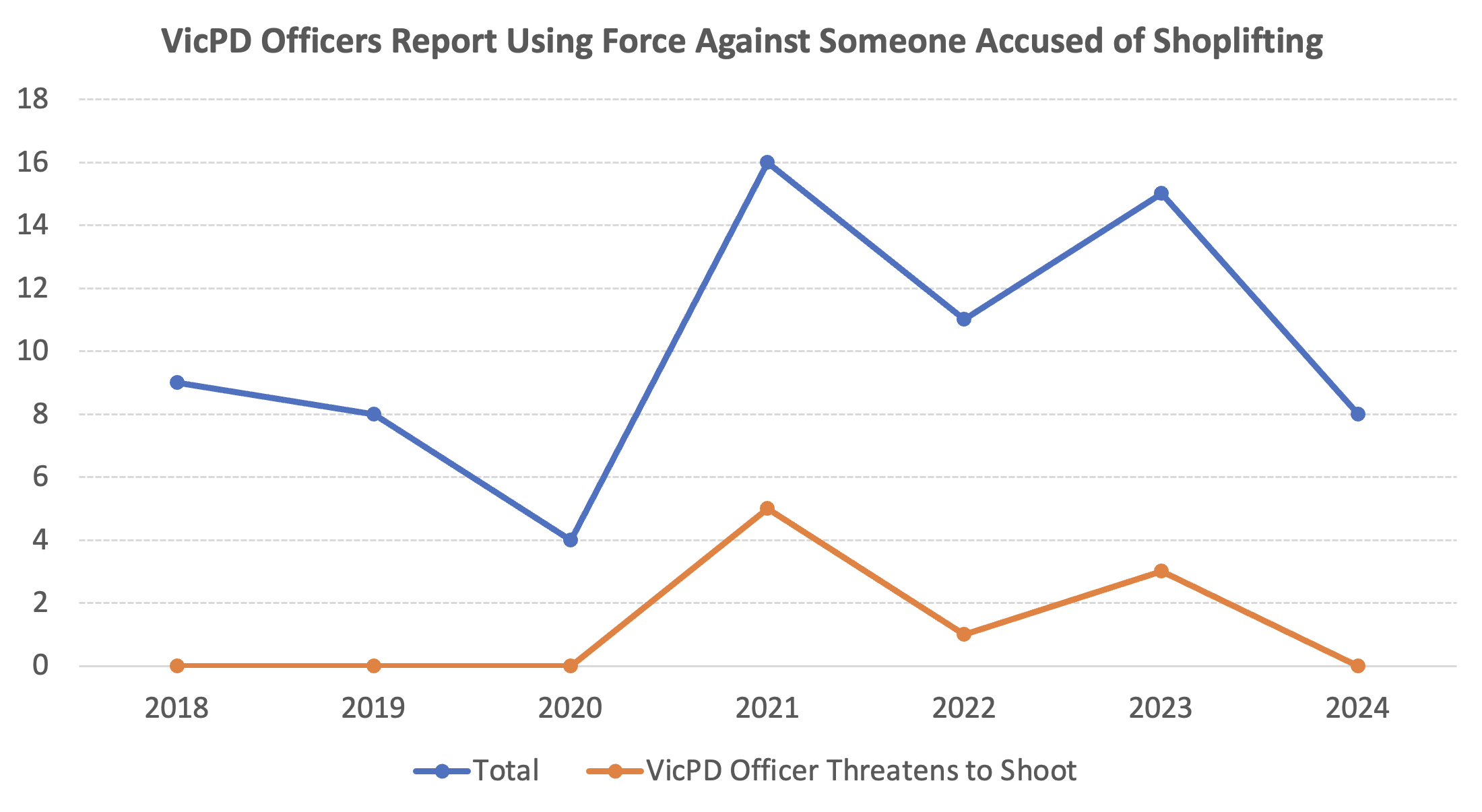
You can also see the potential consequences of police responses to lobbying about shoplifting. In 2021, VicPD advertised a “downtown shoplifting” initiative, and they’ve requested press coverage on multiple similar events since. Between 2018 and 2024, VicPD filed 71 use of force reports where they said the “offence charge” was “shoplifting under $5,000,” with an uptick starting in 2021. Between 2018 and 2020, VicPD says they didn’t threaten to shoot any of those people. But between 2021 and 2023, VicPD officers filed eight reports where they say they threatened to shoot people accused of shoplifting.
No products are worth killing someone to defend.
“Extended range impact weapons”
VicPD is also increasingly using “extended range impact weapons,” particularly “beanbag shotguns.” According to VicPD’s use of force reports, in at least 11 cases where officers used an ARWEN between 2022 and 2024 (a weapon developed “for riot control”), and in at least seven cases where they used a beanbag shotgun, VicPD injured the person. The data does not say if it was the officer’s use of these weapons in particular that injured the person.
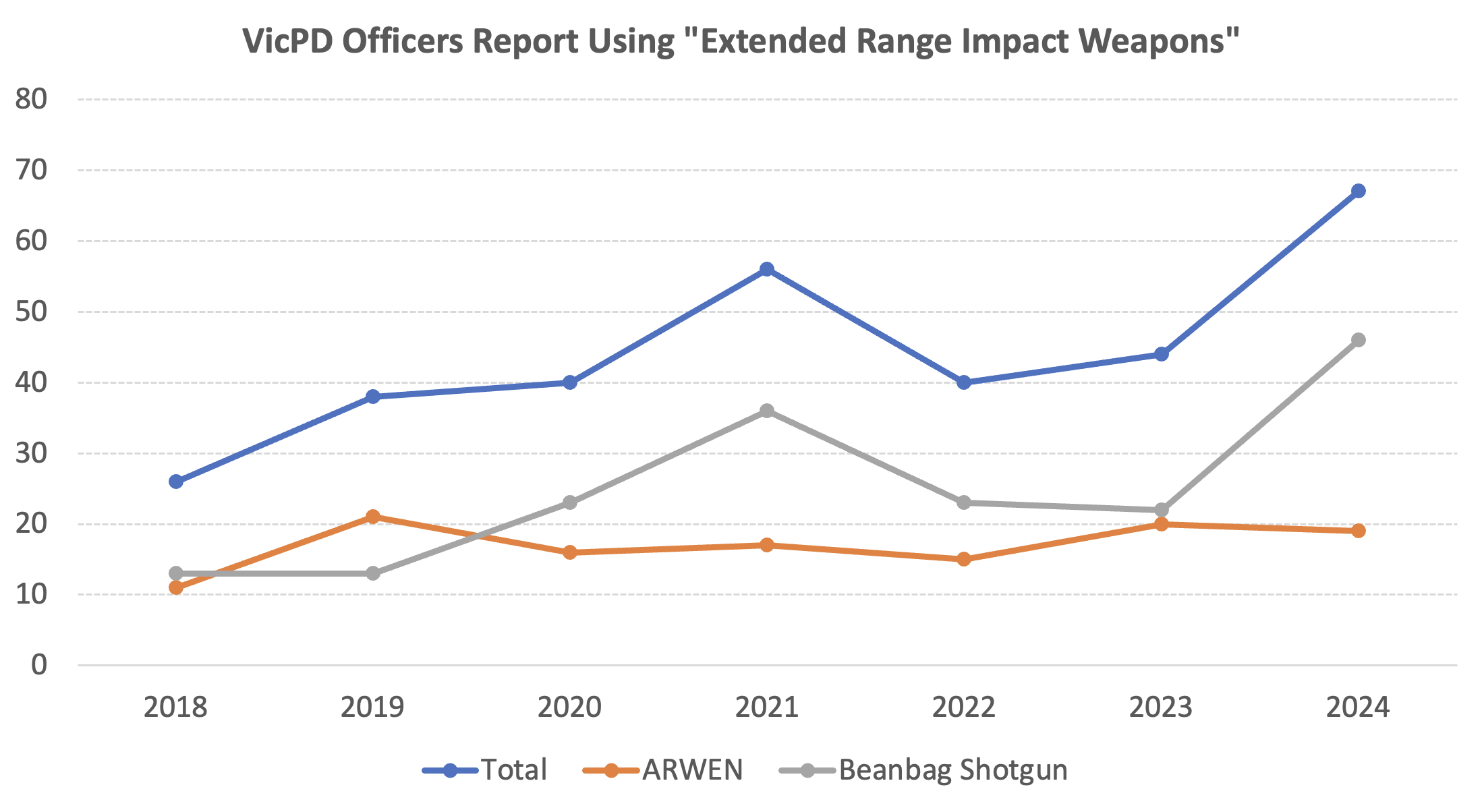
VicPD’s increasing use of these weapons is troubling, because they can kill people. VicPD killed Lisa Rauch in 2019 by shooting her in the back of the head and neck with ARWEN rounds, and the Vancouver Police Department killed Chris Amyotte in 2022 by shooting him in the back with a beanbag shotgun.
VicPD continues to hurt people in crisis
Police are not and will never be mental health professionals, and VicPD’s use of force data provides more evidence that policing mental health puts people in danger.
VicPD filed 508 reports between 2022 and 2024 where they said they used force on someone they believed to be in crisis. That number is likely an undercount, because in addition to VicPD reporting fewer incidents generally, the category is based on officer perception. In 102 reports, VicPD officers say they injured someone they believed was in crisis.
VicPD has insinuated itself into mental health response with support from city council and the provincial government. For example, in 2023, VicPD launched its “Co-Response Team,” pairing police officers with “registered mental health clinicians,” which they said would “ensure … a high level of both mental health care and safety.” Safety for whom? From this data, we can see that VicPD’s Co-Response Team filed at least 17 reports between 2023 and 2024 where the officer says they used force against someone, including three where they said they injured the person.
VicPD’s use of force data also includes a column called “Offence Category,” which includes categories for “Mental Health” and “Mental Health Act.” Neither sound like a crime to me, but it’s a mixed-up world when you’re playing at being a health professional. At first glance, the use of those categories appears to have plummeted almost to zero in 2023, but in this case it’s not just VicPD choosing to report fewer incidents. Instead, the province started redacting the mental health categories in 2023 and 2024 as if they were personal information. According to the data released by the province, VicPD used force at least 84 times in response to “offences” labeled with the mental health categories in 2022, but only 3 in 2023. But that same year, VicPD’s use of force in categories redacted by the province rose from 3 to 59.
VicPD also continues to use force against people during so-called wellness checks. VicPD officers filed 19 reports between 2022 and 2024 where they labeled the “Offence Category” as “check well being.” While those numbers are down, like many figures in this post some of that may be attributable to VicPD’s decision to report fewer incidents.
Finally, the province chose to withhold data on whether the people VicPD used force against were known by the officers to be suicidal. In 2021, the last year where we have data, VicPD officers filed 75 reports where they said they used force against someone they knew to be suicidal.
Vascular neck restraints
The province doesn’t publish data on how often police use vascular neck restraints, which the federal government told the RCMP to stop using in 2022 (not that they listened). This dataset shows that VicPD used vascular neck restraints at least 12 times between 2022 and 2024.
As of 2023, VicPD’s use of force policy said its officers required training in the technique every three years. According to the province, that schedule suggests VicPD officers are supposed to use the technique only when they believe they would be justified in killing the person.
Use of force in police buildings or cells
Since VicPD changed its reporting standards in 2022, the share of VicPD’s use of force reports taking place in police buildings or cells has dropped dramatically, from an average of 12% between 2018 and 2021, to an average of 6% between 2022 and 2024. That could suggest VicPD is using less force on people it’s jailed, or that VicPD’s use of force in cells is now being underreported.
In the past, VicPD said they couldn’t pull reports where people were injured in VicPD cells or headquarters, but it’s clear from the actual dataset that they could have easily identified those reports if they wanted to. Instead, it’s more information that both VicPD and the province choose not to publish.
For any VicPD readers who want to brush up on how to extract this data, here’s a YouTube tutorial on Excel filters.
Using force on people in handcuffs
VicPD continues to use force on people in handcuffs. However, like other reporting categories, the number of incidents appears to have cratered in 2022, dropping by over half, likely due in no small part to VicPD raising its threshold for filing a report. VicPD likely used force on someone in handcuffs far more than the 216 times they reported between 2022 and 2024.
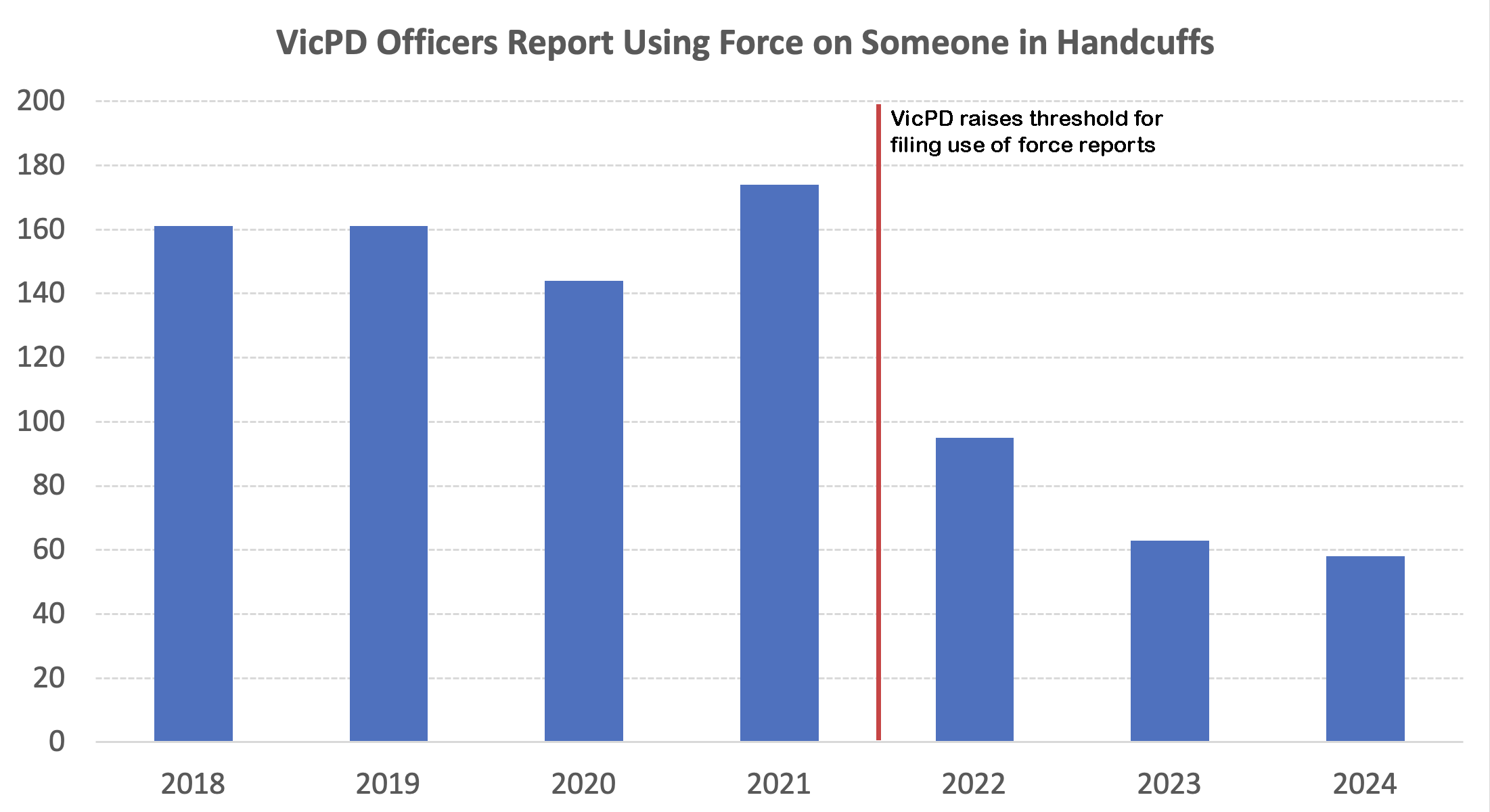
In 2024, one VicPD patrol officer reported “striking” someone in handcuffs five times. Between 2022 and 2024, two VicPD officers also reported pointing a gun at someone in handcuffs, and six officers reported pepper spraying someone already in handcuffs.
What the province withheld
The dataset eventually released via FOI is far more extensive than what the province posts online, but it’s notable that the province still withheld more data than it released in previous years. That includes information on whether officers knew someone was suicidal before they used force, as mentioned above, and how often police violence put someone in hospital. These changes limit the public’s ability to look at data on the effects of allowing police to participate in mental health response, although we know the consequences are real and sometimes fatal.
The province is also withholding data on the gender of the person VicPD used force against, eliminating the ability to perform any type of analysis there, although they publish summary data on the gender of people police use “intermediate weapons” against.
The province also collects information about the years of service of the officers involved in each use of force incident, but they’ve never released it, claiming it’s personal information. Similarly, the province collects officers’ names associated with each report, which would show how often individual officers are hurting people. The province withheld their names as personal information, limiting the public’s ability to hold officers accountable for their actions.
Increasing police secrecy
There’s a reason there’s no 2025 data in this post, and that’s because it was mid-2025 when I first requested this information. From my initial FOI to actually receiving this data took 343 days and multiple complaints to the privacy commissioner. Getting these records was an uphill fight against police and government secrecy, while the government tried to say it wasn’t responsible for the data, even though it requires police departments to collect it and turn it over to the province.
Early in the FOI process, VicPD, which says they’re “always striving to be as transparent and accountable as possible,” instead “requested the records be withheld in their entirety.” The province agreed and said they would withhold the data given “the outcome of consultations,” participating in a trend where VicPD withholds more and more information to limit public scrutiny.


After I filed a complaint with the privacy commissioner, the province released some of the requested data, initially missing all of 2022, which required another formal complaint before they turned it over.
At different times, both the province and VicPD have made additional claims that they couldn’t release use of force data. For this request, the province argued it didn’t have “custody or control” of the data (they very clearly do), suggesting FOI requests for police use of force information should be redirected to individual police departments. By comparison, during previous FOI requests, VicPD has repeatedly denied it can extract information about its officers’ use of force.
The provincial government has an entire website devoted to posting data, and so does VicPD. It’s telling what they choose not to release, or fight to keep secret.
Download the data
In the interests of actual transparency and facilitating research, I combined the 2022 to 2024 data with previously released information from 2018 to 2021. It’s available for download below. I’ve also included some summary statistics, including those noted above, and the data as it was originally sent to me.
At the top of this post, I mentioned the data shows that a VicPD patrol officer threatened to tase someone accused of littering. That’s not something VicPD is going to put in a press release.
I encourage you to download the spreadsheet and do all the analysis that the province and police would rather you didn’t.